
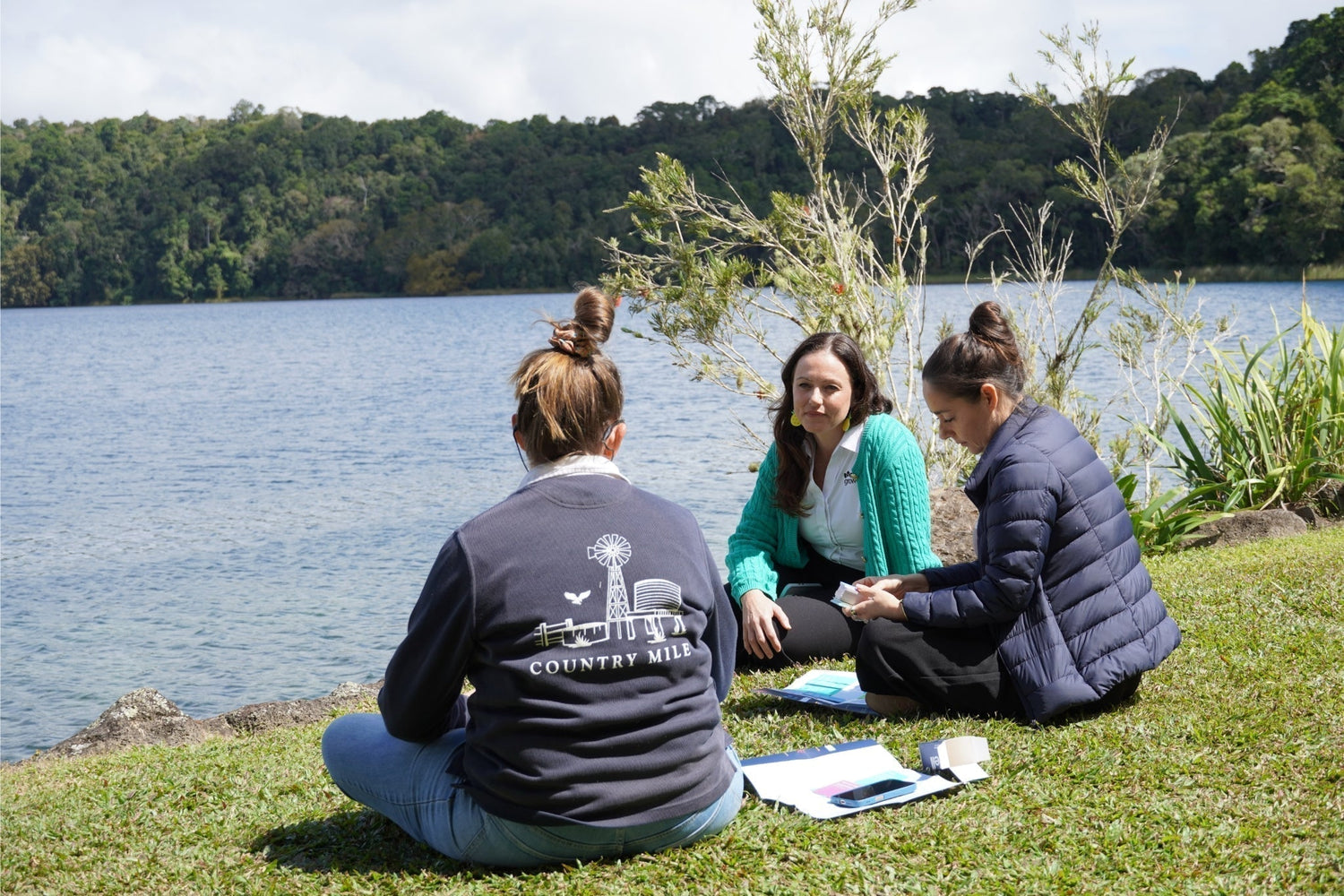
Photo credit: Katherine Kirkwood - QFVG
“While planning for the farm and the business is important, how can you be expected to execute those plans following a disaster if you haven’t been able to care for yourself?"
— Ebony Faichney & Kelly Hodgkinson (Co-founders of FNQ Women in Ag)
On the shores of Lake Barrine, a group of local female growers came together to reflect on what it’s like to experience a natural disaster and rebuild their farms and businesses.
This event was the latest for the Far North Queensland Women in Ag group, established to foster stronger relationships and support networks for female growers in Far North Queensland. The group brings together women from various agricultural sectors to address the unique challenges of primary production.

The Challenge:
Female growers often serve as the backbone of family farms, managing administrative, financial, and compliance work while frequently working in the field and caring for families. In a region prone to severe weather, the pressure of maintaining a business through natural disasters — such as cyclones and droughts — can lead to significant burnout. Many find it difficult to prioritise self-care or step away from day-to-day operations, often waiting until a crisis hits to consider their own wellbeing. As the saying goes: “The time to repair the roof is when the sun is shining.”
The Solution:
Well before the start of the next cyclone season, FNQ Women in Ag partnered with Disastrous to deliver a proactive half-day workshop focused on personal wellbeing and disaster recovery. Supported by Growcom’s Farm Business Resilience and Industry Recovery Programs, the session was designed to help growers reframe their mindsets and set foundations for strength before the next challenge arrives.
The workshop took place at Lake Barrine, where the ancient Kauri pine trees served as a powerful metaphor for endurance. Just as these trees have stood for a thousand years through countless seasons, the participants were encouraged to reflect on the disasters they have already endured and the importance of "coming up for air" to ensure long-term resilience.
Attendees ranged from members of FNQ Growers, Growcom, as well as the Royal Flying Doctor Service and Rural Financial Counselling Service.

Tailored Support:
Disastrous worked with the group to identify practical, sustainable ways to cope with the high-pressure environment of farming. The workshop moved beyond theory into lived experience, facilitating discussions on:
- Micro-Resilience: Identifying specific "quiet spots" or activities on the farm — like listening to a stream — to reset during times of overwhelm.
- The Power of Networks: Strengthening the "I call you" culture, where women feel empowered to lean on their peer network during stressful periods.
- The Power of 'No': Addressing the heavy load of family and farm roles by validating that "No" is a complete sentence and a vital tool for self-preservation.
- The Recovery Journey: Understanding the disaster recovery journey and what it means for life and business on the farm.
Feedback:
The feedback from participants and organisers highlighted the immediate impact of the practical approach:
- Confidence & Connection: Nearly everyone left feeling more confident in facing uncertainty, more connected to others in the room, and more willing to reach out and stay in touch.
- Practical Tools: The disaster cycle walk-through and personal resilience plan activity were standout moments, with many noting how they’ll use these tools in their own lives. “Having Elizabeth walk us through the disaster cycle in plain language was a lightbulb moment.”
- Safe Space: Words like “safe,” “likeminded,” and “supported” came up again and again. For some, it was the first time they’d felt able to share openly about their experiences. “The Cards for Calamity helped put words to what we’ve all been through.”
Ebony Faichney (Co-founder) noted the atmosphere: “The workshop created a supportive, safe space for likeminded women to come together and share their experiences. No matter what activities we do together, creating this kind of environment is what FNQ Women in Ag is about.”
Kelly Hodgkinson (Co-founder) emphasised the shift toward action: “Elizabeth’s practical approach was vital. Growers walked out of the room with specific plans of how they were going to look after themselves.”

Looking Forward:
By prioritising self-care during the "sunny days," the women of FNQ Growers and Growcom have built a stronger foundation for the seasons ahead. The commitment to say 'no' to over-extension and 'yes' to community support ensures that these businesses — and the women who run them — are better prepared to navigate the ebbs and flows of the agricultural industry.
Case study references a wonderful blog written by our friends at Growcom.
Photo credit: Katherine Kirkwood QFVG
The Farm Business Resilience Program is jointly funded through the Australian Government’s Future Drought Fund and the Queensland Government’s Drought and Climate Adaptation Program.

Leave a comment
This site is protected by hCaptcha and the hCaptcha Privacy Policy and Terms of Service apply.